



This market research study involved the extensive use of secondary sources, directories, and databases to identify and collect information useful for this technical, market-oriented, and financial study of the clinical analytics market. In-depth interviews were conducted with various primary respondents, including key industry participants, subject-matter experts (SMEs), C-level executives of key market players, and industry consultants, among other experts, to obtain and verify critical qualitative and quantitative information and to assess market prospects. The size of the clinical analytics market was estimated through various secondary research approaches and triangulated with inputs from primary research to arrive at the final market size.
Secondary Research
The secondary research process involved the widespread use of secondary sources, directories, databases (such as Bloomberg Businessweek, Factiva, and D&B Hoovers), white papers, annual reports, company house documents, investor presentations, and SEC filings of companies. Some non-exclusive secondary sources include the World Health Organization (WHO), the Organization for Economic Co-operation and Development (OECD), Healthcare Information and Management Systems Society (HIMSS), Centers for Disease Control and Prevention (CDC), ClinicalTrials.gov, Expert Interviews, and MarketsandMarkets Analysis.
Secondary research was used to identify and collect information useful for the extensive, technical, market-oriented, and commercial study of the clinical analytics market. It was also used to obtain important information about the key players and market classification and segmentation according to industry trends, to the bottom-most level, and key developments related to market and technology perspectives. A database of the key industry leaders was also prepared using secondary research.
Primary Research
In the primary research process, various sources from both the supply and demand sides were interviewed to obtain qualitative and quantitative information for this report. Primary sources are mainly industry experts from the core and related industries and preferred suppliers, manufacturers, distributors, technology developers, researchers, and organizations related to all segments of this industry’s value chain. In-depth interviews were conducted with various primary respondents, including key industry participants, subject-matter experts (SMEs), C-level executives of key market players, and industry consultants, among other experts, to obtain and verify the critical qualitative and quantitative information as well as assess prospects.
Primary research was conducted to identify segmentation types, industry trends, key players, and key market dynamics such as drivers, restraints, opportunities, challenges, and strategies adopted by key players.
After completing the market engineering process, which includes calculations for market statistics, market breakdown, size estimations, forecasting, and data triangulation, extensive primary research was conducted. This research aimed to gather information and verify the critical numbers obtained during the market analysis. Additionally, primary research was conducted to identify different types of market segmentation, analyze industry trends, evaluate the competitive landscape of clinical analytics offered by various players, and understand key market dynamics such as drivers, restraints, opportunities, challenges, industry trends, and strategies employed by key market participants.
In the complete market engineering process, the top-down and bottom-up approaches and several data triangulation methods were extensively used to perform the market estimation and market forecasting for the overall market segments and subsegments listed in this report. Extensive qualitative and quantitative analysis was performed on the complete market engineering process to list the key information/insights throughout the report.
Breakdown of Primary Interviews
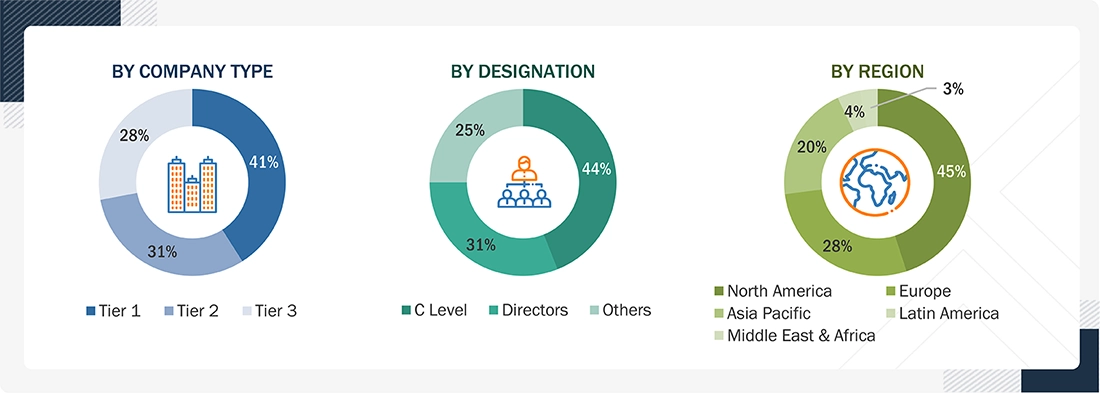

Note 1: Other designations include sales, marketing, and product managers.
Note 2: Tiers are defined based on a company’s total revenue, as of 2024: Tier 1 = >USD 1 billion, Tier 2 = USD 500 million to USD 1 billion, and Tier 3 = < USD 500 million.
To know about the assumptions considered for the study, download the pdf brochure
Market Size Estimation
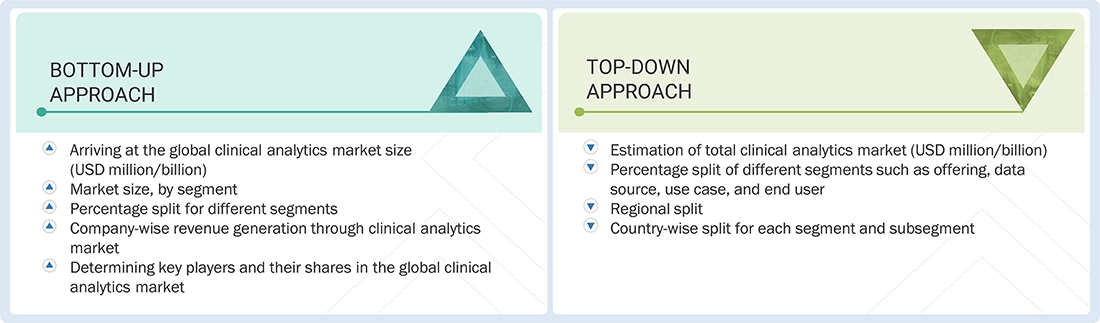
The market size estimates and forecasts provided in this study are derived through a mix of the bottom-up approach (revenue share analysis of leading players) and the top-down approach (assessment of utilization/adoption/penetration trends, by offering, mode of interaction, application, end user, and region).

Data Triangulation
After arriving at the overall market size, from the market size estimation process explained above, the clinical analytics market was split into segments and subsegments. To complete the overall market engineering process and to arrive at the exact statistics for all segments and subsegments, data triangulation and market breakdown procedures were employed, wherever applicable. The data was triangulated by studying various factors and trends from both the demand and supply sides in the clinical analytics market.
Market Definition
The clinical analytics market comprises technologies and software solutions that collect, analyze, and interpret clinical data to support evidence-based decision-making, optimize care delivery, and enhance operational efficiency. Leveraging AI, machine learning, predictive modeling, and data visualization, these platforms transform data from EHRs, medical imaging, labs, and other sources into actionable insights. They enable applications such as clinical decision support, disease surveillance, care coordination, quality improvement, and population health management, helping healthcare providers, payers, life sciences organizations, and public health agencies improve patient outcomes, drive value-based care, streamline workflows, and reduce costs through both real-time and retrospective analytics.
Stakeholders
- Clinical Analytics Software & Solution Providers (including AI-driven analytics vendors, predictive analytics platforms, and reporting software developers)
- Healthcare Providers (Hospitals, Outpatient Clinics, Specialty Care Centers, Telehealth Providers, Primary Care Centers, Long-term & Elder Care Facilities, Mental Health Clinics)
- Payers & Insurers
- Research & Development (R&D) Companies
- Population Health Management & Remote Monitoring Service Providers
- Consulting, Training & Implementation Service Providers (workflow optimization, analytics integration, clinical decision support)
- Medical Research Laboratories & Clinical Trial Organizations
- Academic Medical Centers/Universities/Research Institutes
- Regulatory & Compliance Bodies (e.g., FDA, EMA, HIPAA regulators)
- Data & Algorithm Developers (AI/ML specialists, predictive modeling experts, data scientists)
- Technology Infrastructure Providers (cloud platforms, EHR/PACS integrators, data storage & security providers)
- Venture Capitalists & Private Equity Firms
- Advocacy Groups & Professional Associations
- Investors & Financial Institutions
Report Objectives
- To define, describe, and forecast the clinical analytics market by offering, data source, use case, end user, and region
- To provide detailed information regarding the major drivers, restraints, opportunities, and challenges influencing market growth
- To strategically analyze micromarkets with respect to individual growth trends, prospects, and contributions to the overall clinical analytics market
- To analyze market opportunities for stakeholders and provide details of the competitive landscape for key players
- To forecast the size of the clinical analytics market in five main regions (and their respective countries): North America, Europe, Asia Pacific, the Middle East & Africa, and Latin America
- To provide key industry insights, such as ecosystem, value chain, technology, regulatory, patent, and the impact of the US tariff analysis
- To profile the key players in the market and comprehensively analyze their core competencies
- To track and analyze competitive developments, such as product launches & upgrades, collaborations, partnerships, acquisitions, investments, contracts, agreements, alliances, mergers, funding, and expansions of the leading players in the market
- To benchmark players within the market using the company evaluation matrix, which analyzes market players on various parameters within the broad categories of business strategy, market share, and product offering
link