
Analysis and prediction of the incidence temporal trends of echinococcosis in China from 2010 to 2021
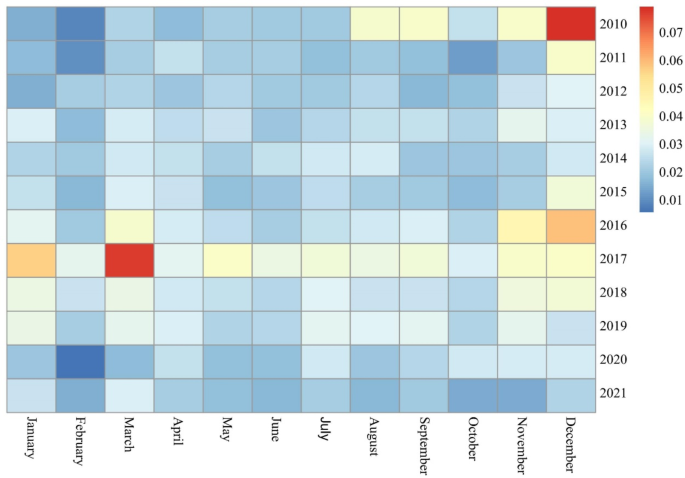
This study reveals that the average incidence of echinococcosis in China from 2010 to 2021 was 0.320 per 100,000 individuals, with the lowest rate recorded at 0.242 per 100,000 in 2021. This figure surpasses the incidence of 0.15 per 100,000 individuals observed in European Union (EU) countries20, indicating that there is still room for further improvement in the prevention and control of echinococcosis in China. Another study has shown that between 2004 and 2013, the average incidence rate of echinococcosis in China was 0.18 per 100,000, demonstrating a significant increasing trend (APC = 24.0%, 95% CI: 12.0–37.2%, P < 0.05)21. From 2004 to 2019, the average incidence rate of echinococcosis rose to 0.228 per 100,000, with an overall trend of initially increasing and then decreasing, peaking in 2017 22. This trend aligns well with the findings of our study, further confirming the prevalence of echinococcosis in China in recent years. It is noteworthy that, despite a decrease in the incidence rate of echinococcosis between 2019 and 2021, it still remains higher than the average for the period from 2004 to 2019. This indicates that the prevention and control efforts for echinococcosis in China continue to face significant challenges. Moreover, the incidence of echinococcosis varies greatly among provinces (cities and autonomous regions) in China. Studies have indicated that the incidence in southern Xinjiang and Qinghai Province is significantly higher than the national average23,24. In contrast, Yunnan Province, while being an endemic area for echinococcosis, has an incidence rate that is considerably lower than the national average25. The prevention and control of echinococcosis in Xinjiang and Qinghai Province still faces challenges.
Over the period from 2010 to 2021, the incidence of echinococcosis displayed a general downward trend, albeit at a gradual pace. Notably, the proactive initiation of the echinococcosis prevention and control program by the Chinese government in 2005 has led to noteworthy achievements, resulting in a measurable containment of the disease’s spread. However, despite these efforts, the increasing intensity of screening activities, coupled with the adoption of advanced diagnostic techniques, has led to the identification of a higher number of echinococcosis patients26,27. This observation underscores the fact that, while progress has been made, the disease remains prevalent in certain populations. Moreover, a persistent challenge lies in stemming the transmission of echinococcosis among wild canids, primarily due to the limited availability or inefficiency of effective intervention strategies. This obstacle highlights the need for further research and innovation in this area. Given the aforementioned factors, it is evident that, despite the implementation of various prevention and control measures, there has not been a marked reduction in the prevalence of echinococcosis. This underscores the complexity of the disease and the need for a comprehensive, multifaceted approach to tackle it effectively.
The trend from 2010 to 2014 remained consistent with the overall pattern observed throughout the study period, displaying a non-significant decrease in incidence. Notably, the implementation of the National Action Plan for Echinococcosis Control (2011–2015) yielded incremental success in both dog and patient management, consequently leading to an increase in cases detected through screening27. The incidence of echinococcosis increased significantly from 2014 to 2017. In 2016, the Chinese Center for Disease Control and Prevention carried out echinococcosis screening in nine provinces (autonomous regions), including Inner Mongolia, Sichuan, Tibet, Shaanxi, Gansu, Qinghai, Ningxia, Yunnan, and Xinjiang (including the Xinjiang Production and Construction Corps). Additionally, since 2016, the national echinococcosis surveillance system has been established, and these measures have facilitated the progressive identification of echinococcosis cases, resulting in an escalating incidence rate10,27.
The incidence of echinococcosis exhibited a significant declining trend from 2017 to 2021, which aligns with the findings reported by Kui Yan et al.28. The Tibet Autonomous Region has the highest prevalence of echinococcosis. In the period from 2017 to 2019, the regional government implemented a comprehensive three-year prevention and control strategy for echinococcosis, resulting in a significant reduction in transmission risk29. Due to the effective implementation of comprehensive prevention measures, the incidence of echinococcosis in Xinjiang has decreased since 2017 23. The period from 2015 to 2018 saw the implementation of an integrated prevention and control project in Shiqu County, which included comprehensive patient treatment and host management strategies, leading to initial successes in controlling the disease source30. Simultaneously, as a result of implementing the “National Echinococcosis and Other Key Parasitic Disease Control Plans (2016–2020),” coupled with intensified government efforts in prevention and control measures against echinococcosis and successful policy implementations, a declining trend in the incidence of echinococcosis has been observed in high-risk areas such as Qinghai Province, Sichuan Province, and the Tibet Autonomous Region31.
Throughout the study period, the incidence of echinococcosis peaked in 2017. Two possible reasons for this phenomenon can be identified. Firstly, Xinjiang included echinococcosis in the national physical examination starting from that year, effectively expanding screening coverage and enhancing population detection rates23. Secondly, in 2017, the Tibet Autonomous Region conducted a comprehensive screening program targeting the entire population, achieving a coverage rate of over 90%. This extensive screening effort led to the highest detection rate of echinococcosis recorded29. The incidence of echinococcosis in 2021 reached its lowest point, largely attributed to the continuous decline observed since 2017, which can be primarily credited to the Chinese government’s unwavering commitment towards addressing this issue and implementing a comprehensive set of preventive and control measures.
This study also revealed that the peak incidence of echinococcosis consistently occurred in December each year, which can be attributed to the winter slaughter season observed in pastoral areas from November to December. During this period, domestic canines are at a heightened risk of infection due to their exposure to infected organs. Furthermore, empirical evidence suggests that domestic canines may exhibit heightened exposure to small mammalian species during the onset of winter, consequently leading to a substantial escalation in susceptibility to Echinococcus infection32,33. Foxes serve as the predominant definitive hosts for Echinococcus multilocularis, with their AE infections peaking during winter. Additionally, a significant positive correlation exists between the occurrence of human AE and the prevalence of foxes34,35,36. Research has also demonstrated that both AE infection in small mammals and CE infection in cattle exhibit a winter peak37,38, mirroring the potential seasonal pattern observed in human infections as intermediate hosts. The winter-induced decline in human immune function is likely to expedite the progression of Echinococcus tapeworm infection within the body, leading to the manifestation of associated clinical symptoms39. Furthermore, given the heightened prevalence of respiratory ailments during this season, patients may be identified through more frequent hospital admissions even before symptom onset40,41. Based on the consolidation of echinococcosis control effectiveness, this study recommends that relevant departments rigorously implement canid deworming measures during winter. Strengthening grassland management and implementing effective control measures for small rodent populations are also advised. Additionally, facilitating the establishment of centralized slaughterhouses while developing standardized regulations will ensure proper management practices within these facilities. This will enable the safe disposal of infected organs and prohibit their use as feed for dogs. In winter, enhancing nutritional intake, engaging in appropriate physical activity, and bolstering the body’s immune response are essential.
The SARIMA model has a simple structure, requires only morbidity information for prediction, is highly feasible, and has been widely used in healthcare42. Furthermore, research has demonstrated that the automated SARIMA model exhibits greater robustness in time series predictions compared to the manual SARIMA model13. The prediction results were largely consistent with observed trends, showing similar values. Additionally, the MAPE between the actual and predicted values was calculated to be 10.420%. The results indicated that the model displayed a strong fitting effect and had the capability to accurately forecast future incidences of echinococcosis. Based on the projected incidence, it is expected that the prevalence of echinococcosis will experience a slight increase from September 2022 to August 2025. By further strengthening prevention and control measures while consolidating existing effectiveness, it is anticipated that future incidences can be reduced.
Despite these advancements, this study exhibits several limitations. Firstly, the lack of comprehensive sociodemographic data and the absence of stratified analyses constrain our ability to explore the unique pathogenic characteristics of echinococcosis within the Chinese context. Although this study was unable to obtain these data, preventing further analysis of the epidemiological characteristics of echinococcosis across different populations in China, we conducted a preliminary exploration of this variability by introducing an analysis of echinococcosis in Tibet Autonomous Region. Our research findings indicate that between 2019 and 2023, the incidence of echinococcosis in females in Tibet Autonomous Region was significantly higher than that in males, with the incidence in the ≥ 60 years age group being notably higher than in other age groups, and showing a significant increasing trend from younger to older age groups (Table S2). This analysis suggests that there are indeed significant differences in the incidence of echinococcosis among populations of different genders and age groups. In future studies, we will endeavor to obtain more data on the sociodemographic characteristics of patients and conduct in-depth analyses of the associations between these factors and the incidence of echinococcosis. Secondly, the lack of specific incidence data at the provincial (city and autonomous region) level poses challenges in accurately assessing regional variations in disease burden and evaluating the impact of prevention and control strategies across diverse geographical areas. Finally, we acknowledge that potential issues within the reporting system, such as underreporting and misreporting, may lead to discrepancies between the reported incidence figures and the true prevalence of echinococcosis28. To address this issue, we propose several measures: firstly, conducting rigorous review and validation of data during the collection phase to ensure its accuracy and completeness. Secondly, strictly adhering to the diagnostic procedures for echinococcosis to minimize misreporting. Additionally, we recommend introducing automated data input tools to reduce human errors and omissions, while also providing regular training for data input personnel to enhance their accuracy and sense of responsibility. Lastly, we suggest establishing a data quality monitoring platform that visually displays cases of underreporting, enabling managers to take swift action.
link



![Average Cost of Medical School [2025]: Yearly + Total Costs](https://educationdata.org/wp-content/uploads/2025/09/page-1.png "Average Cost of Medical School [2025]: Yearly + Total Costs")