
Trend analysis and prediction of disease burden of occupational carbon monoxide poisoning in China based on the past two decades
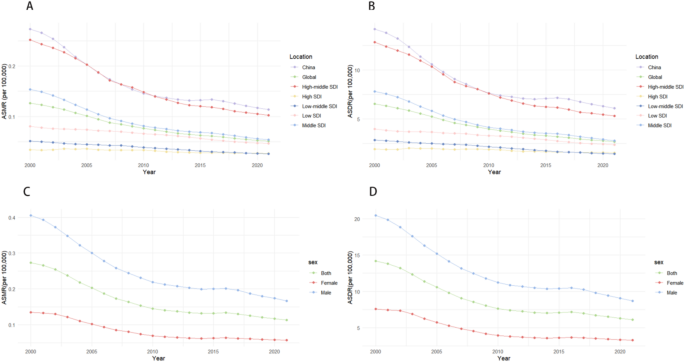
Occupational CO poisoning, as the most common occupational disease, represents a huge burden of disease in China and in countries around the world12. The present study thoroughly analyzed the changes in the burden of disease attributable to occupational factors of CO poisoning in China from 2000 to 2021, as well as the trend prediction. The results of this study show that the overall trend of ASMR and ASDR in China is decreasing during 2000–2021, indicating that China has made some achievements in occupational safety and health and in the treatment and prognosis of occupational diseases in the 21st century. This may be related to the fact that hyperbaric oxygen and the combination of hyperbaric oxygen with various therapeutic measures or drugs have been popularized and extensively studied in China. Hyperbaric oxygen, as an effective treatment for CO poisoning, can effectively reduce the mortality rate of CO poisoning, prevent the occurrence of delayed-onset neuropathy in CO poisoning, and improve the prognosis of patients, thus reducing DALYs13. Some studies have shown that the combination of hyperbaric oxygen with various therapeutic measures or drugs, such as adjunctive therapeutic hypothermia14, edaravone15, dexamethasone16, etc., can achieve better results than hyperbaric oxygen therapy alone.
However, compared with global data and data from different SDI regions, China has consistently high levels of ASMR and ASDR. This phenomenon may be attributed to multilevel structural differences. On the one hand, the uneven distribution of medical resources significantly affects the efficiency of treatment, which is significantly lower in western China than in eastern China17.On the other hand, it can be attributed to the weak implementation of occupational safety supervision, as China’s grass-roots health management suffers from the problems of “insufficient specialized personnel and outdated technology and equipment”, especially the general lack of occupational health managers in small, medium-sized and microenterprises, leading to insufficient monitoring of the risk of occupational exposure18.In addition, underreporting of occupational poisoning and differences in the industrial structure of different countries may lead to some differences in the severity of the disease burden.
The results of the analysis showed that the ASMR and ASDR for occupationally attributable CO poisoning were decreasing in both males and females in China, and that the burden of disease was consistently higher in males than in females, which is consistent with the results of the previous studies of occupationally attributable and non-occupationally attributable CO poisoning16.This phenomenon may be due to a combination of multiple factors. Physiologically, it has been shown that women have a better prognosis for CO poisoning than men, with a more efficient CO clearance capacity19.In terms of socio-cultural factors. Traditional gender roles may limit women’s access to high-risk jobs. In China, among workers in occupations requiring proximity to combustion sources and CO-emitting equipment, such as train drivers, miners and firefighters, men are better suited to these jobs than women in terms of strength and robustness, and thus the proportion of men is usually greater than that of women, and thus the exposure is greater than that of women20,21. In terms of occupational distribution, there may be gender segregation in occupational distribution. Although China does not officially publish sex specific data on occupational exposure, international studies have shown that high-risk industries (e.g., mining, manufacturing, transportation) are generally male-dominated, while females are more concentrated in the service sector or in low-exposure light industry22.For example, the International Labor Organization (ILO) report explicitly mentions that only about 20% of the 21.4 million jobs in the male-dominated mining industry are held by women23. The above discussion reflects the importance of gender differences in occupational safety training. Customized safety education for male workers (e.g., virtual reality simulation training) may be more effective in reducing risk.
An analysis of mortality rates and DALYs for occupationally attributable CO poisoning in different age groups over 15 years of age in China showed that both mortality and DALYs rates showed an increasing and then decreasing trend, with a peak in the 20–29 age range and a subsequent decrease, while the decreasing trend of mortality was slightly more moderate than that of DALYs, and the rates of mortality as well as DALYs for males were consistently higher than those for females. The presence of peak mortality rates in the 25–29 age group may be related to the fact that young people aged 25–29 years are more likely to be employed in high-risk occupations, such as manufacturing, construction, and mining, which often involve combustion sources and CO-emitting equipment, thereby increasing their risk of exposure to CO24. The peak occurrence of DALYs is also seen in the 25–29 age group, and the high DALYs values may reflect the severe impact of CO poisoning on the health and productivity of young people, as these populations are usually at the beginning of their careers and their early death or disability has a greater social and economic impact. The results of this study suggest that the development and implementation of more effective occupational safety and health education programs for young people in this age group should be strengthened, as well as enhanced safety regulation and preventive measures in the workplace.
In this study, we used the ARIMA (0, 2, 1) model to predict the trends of ASMR and ASDR for CO poisoning attributable to occupational factors in China over the next 10 years. The predicted results showed that the ASMR and ASDR were decreasing in the next 10 years. It shows that, since the beginning of 21st century, with the continuous progress of medical care and the amendment of the Law of the People’s Republic of China on Prevention and Control of Occupational Diseases, which was formulated according to the Constitution, not only strengthened the responsibility of enterprises, but also promoted the establishment of a monitoring system for occupational exposures, China gradually emphasized the development of occupational diseases, and made certain achievements in occupational disease prevention and control25.
This study has the following limitations. First, geographic and data coverage limitations: based on nationally aggregated data, it is not possible to parse out regional differences, and future targeted policies will need to be developed in conjunction with provincial data. Second, GBD2021 data bias: as GBD data are derived through modeling and may rely on inconsistent or incomplete local reports. In China, the occupational health surveillance system does not yet fully cover MSMEs and the informal sector, so the risk of underreporting and misclassification bias is high. Third, exposure heterogeneity is not differentiated: the GBD does not separate the difference in impacts between long-term low and short-term high exposures, and the type of exposure needs to be refined in conjunction with the Chinese Classification of Occupational Diseases (CCOD). Fourth, the model variables are missing: the ARIMA model does not incorporate exogenous variables (e.g., industrial policy adjustments), and it is suggested that the ARIMAX model be constructed by integrating enterprise emission data to improve the prediction accuracy in the future.
link


![Average Cost of Medical School [2025]: Yearly + Total Costs](https://educationdata.org/wp-content/uploads/2025/09/page-1.png "Average Cost of Medical School [2025]: Yearly + Total Costs")